Hegseth warns some NATO allies will 'fail' his review for free-riding on US defence. Europe says it already raised spending €90bn.
US Defence Secretary Pete Hegseth told NATO defence ministers in Brussels that he is launching a review — 'NATO 3.0' — to assess which member states are pulling their weight and which are free-riding. He said some countries 'will fail and others will pass with flying colours,' singled out allies that limited help during the Iran war, and insisted the US target of 5% of GDP for defence and related infrastructure was non-negotiable. NATO Secretary-General Mark Rutte pushed back, noting that European defence spending had already jumped €90bn last year — a 20% rise — and that Europeans are 'already backfilling' resources the US is cutting back on.
The summary above is a neutral framing. Below, each side reports the same story in its own words — judge for yourself.
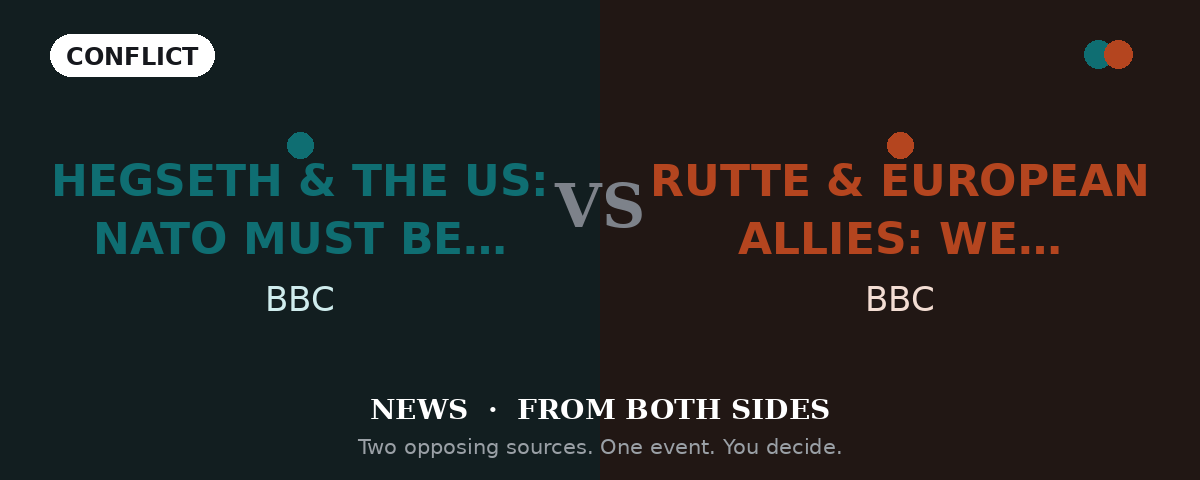
Pete Hegseth told the Brussels meeting that his 'NATO 3.0' review would identify countries that were free-riding on American security guarantees, and that some would 'fail.' He was especially critical of allies that placed limits on assistance to US forces during the war with Iran, framing this as unacceptable dependence on American protection without full solidarity in return. Hegseth said the goal was to 'ensure that NATO is moving fast and irreversibly toward Europe leading' on the continent's own security — a signal that US commitment is conditional on allies reaching the agreed 5% of GDP spending target (3.5% defence + 1.5% related infrastructure).
NATO Secretary-General Mark Rutte responded to Hegseth by pointing out that European defence spending had already risen by €90bn — nearly 20% — in the past year alone, and that Europeans are 'already backfilling' capacity that the US is scaling back. Allies note that the US itself has been reducing certain European commitments while demanding allies spend more, and that the Iran war demonstrated Europe's willingness to contribute. Critics of Hegseth's 'NATO 3.0' framing argue that transactional conditionality — threatening to fail allies in a review — undermines the collective defence guarantee that has kept peace in Europe for 75 years.