The US Congress moves to block state AI laws with a single federal bill: unified standards, or silencing communities before they can act?
House lawmakers released the draft 'Great American AI Act' (GAAIA) — backed by the White House — which would impose a three-year preemption on state AI regulations covering the development of certain AI models. Proponents say the patchwork of thousands of state laws creates an innovation-killing regulatory maze that only a unified federal standard can replace. A coalition of state legislators immediately fired back, writing to Congress that the bill would 'tie the hands of lawmakers at a moment of rapid technological transformation,' freezing the ability of states to protect consumers, parents, artists and workers from AI's known harms.
The summary above is a neutral framing. Below, each side reports the same story in its own words — judge for yourself.
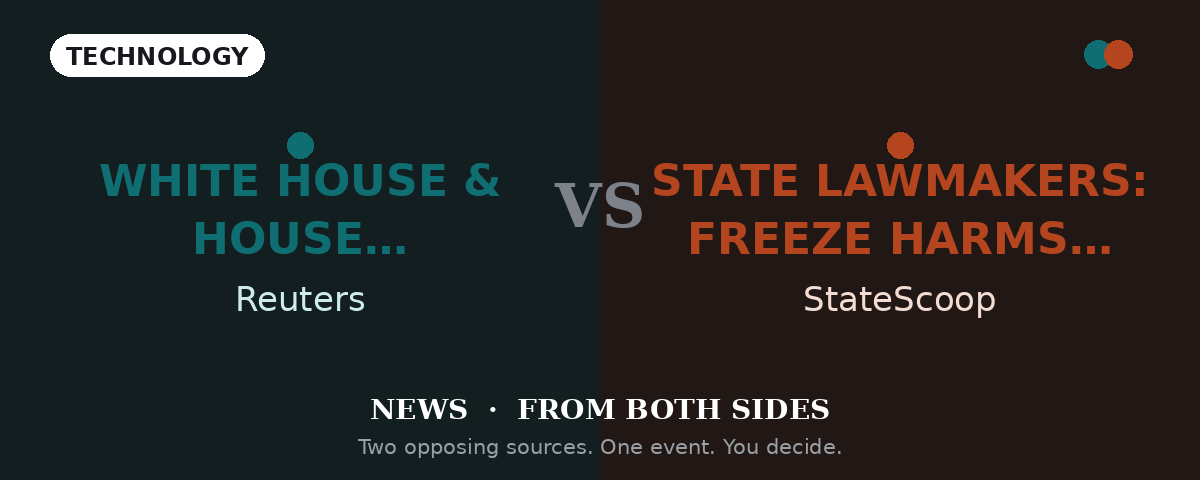
The White House and House lawmakers relaunched a push to preempt state AI laws with a unified federal framework — the 'Great American AI Act' (GAAIA) — arguing that thousands of differing state regulations create a 'cumbersome' and innovation-blocking maze for AI developers. The draft bill would impose a three-year preemption on state AI laws regulating the development of certain models, while allowing states to regulate AI at the deployment stage and pass laws of 'general applicability.' The White House's national AI policy framework describes the push as establishing a rational, innovation-friendly national standard rather than letting a patchwork of conflicting state rules determine how the most consequential technology of the decade is built.
A coalition of state legislators wrote to Congress urging rejection of GAAIA's three-year preemption, warning the bill would 'tie the hands of lawmakers at a moment of rapid technological transformation' and impact a 'sweeping set of state laws.' The letter — organised by the nonprofit Americans for Responsible Innovation — cited constituents' concerns about AI's threats to safety, livelihoods, privacy and cybersecurity. 'In the face of such fast-moving technology, state lawmakers have a critical role to play in protecting our communities,' the legislators wrote. 'At its core, our system of government protects the ability of states to act as laboratories of democracy, responsive to constituent concerns. Freezing the ability of state lawmakers to address AI harms fundamentally violates that principle.'